5 AI Implementation Mistakes That Derail Results — And How to Avoid Them
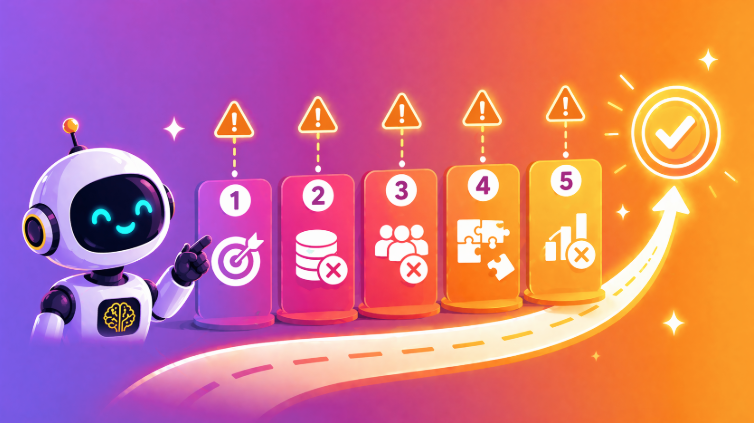
The data on AI adoption is both exciting and sobering. Organizations worldwide are investing at an unprecedented scale — total corporate AI investment reached $252.3 billion in 2024, according to tracking by Fullview.io. Yet the returns have been uneven at best. The MIT NANDA initiative's State of AI in Business 2025 report found that 95% of enterprise generative AI pilots fail to deliver measurable impact on the bottom line. RAND Corporation's analysis puts overall AI project failure rates above 80% — exactly twice the failure rate of non-AI technology projects.
The question is not whether AI works. It does, for the organizations that implement it correctly. The question is why so many implementations fall short — and what can be done differently.
The answer, consistently, is not the technology. It is the strategy, the data, the people, and the process surrounding it.
This post identifies five of the most common AI implementation mistakes, grounded in research from MIT, McKinsey, Gartner, RAND Corporation, and S&P Global. More importantly, it outlines what organizations can do to avoid each one.
95% of enterprise GenAI pilots fail to deliver measurable P&L impact (MIT NANDA, 2025)
42% of companies abandoned most AI initiatives in 2025, up from 17% in 2024 (S&P Global)
80% of AI projects fail — 2x the rate of non-AI tech projects (RAND Corporation, 2024)
MISTAKE 01: Starting with Technology Instead of Business Problems
The most common and costly AI implementation mistake is starting with the tool rather than the problem. Organizations purchase AI platforms, deploy large language models, or build internal AI systems before they have clearly defined what specific business challenge they are solving — and how they will measure success.
IBM Senior Research Scientist Marina Danilevsky described this pattern plainly: "People said, 'Step one: we're going to use LLMs. Step two: What should we use them for?'" As FullStack Labs documented in their 2025 analysis, this disconnect between hype and functionality costs organizations millions in wasted time and resources.
Gartner's research reinforces this finding. The firm indicates that more than 40% of agentic AI projects will be canceled by 2027, largely because organizations pursue AI based on technological fascination rather than concrete business value. Meanwhile, a Gallup poll from late 2024 found that only 15% of U.S. employees report their workplaces have communicated a clear AI strategy.
The organizations that succeed do the opposite. WorkOS's analysis of successful enterprise AI deployments found that the most reliable predictor of success is starting with business pain, not technical capability. Lumen Technologies offers a concrete example: their sales teams spent four hours researching customer backgrounds before outreach calls. The company identified that as a $50 million annual cost — and only then designed AI integrations to address it. The result was research time compressed to 15 minutes per call.
How to Avoid It
- Define the problem first. Before evaluating any AI tool, write a clear problem statement: What process is broken or inefficient? What does it cost the organization today? What does success look like in measurable terms?
- Set specific, measurable goals. Vague objectives like "improve efficiency" or "leverage AI" are not implementation goals. Specific goals — reduce response time by 30%, eliminate manual data entry for 500 records per week — create accountability and clear benchmarks.
- Validate before scaling. Pilot on a single, high-impact use case. Prove measurable value before expanding to additional workflows or departments.
MISTAKE 02: Underestimating the Data Problem
AI systems are only as reliable as the data that feeds them. Poor data quality is not a peripheral issue in AI implementation — it is the leading cause of failure. And yet organizations routinely underestimate how significant the data challenge is before they begin.
Informatica's CDO Insights 2025 survey identified data quality and readiness as the top obstacle to AI success, cited by 43% of respondents — tied with lack of technical maturity. Gartner predicts that through 2026, organizations will abandon 60% of AI projects due to insufficient data quality. The firm also estimates that bad data costs organizations an average of $12.9 million annually in wasted resources, failed projects, and reputational damage.
A 2025 research study on data quality and machine learning performance found a direct correlation: algorithms tested suffered measurable performance degradation as their data was polluted. Even 20% data contamination caused a 10% drop in model accuracy. For AI applications making real-time customer decisions, that margin is not acceptable.
Publicis Sapient's 2026 Guide to Next industry trends report was direct: "AI won't fail for lack of models. It will fail for lack of data discipline." Their survey of more than 500 industry leaders found that while 91% of organizations acknowledge a reliable data foundation is essential for AI success, only 55% believe their organization actually has one.
How to Avoid It
- Conduct a data readiness audit before implementation. Assess data completeness, accuracy, consistency, and recency for the specific AI use case. Do not assume existing data is "good enough" without verification.
- Invest disproportionately in data preparation. WorkOS's analysis of successful deployments found that winning programs earmark 50-70% of the timeline and budget for data readiness — extraction, normalization, governance, quality dashboards, and retention controls.
- Establish ongoing data governance. Gartner recommends treating AI-ready data as a practice, not a one-time project. Data management infrastructure requires continuous improvement as AI use cases evolve.
- Assign data stewardship. Unclear ownership of data quality is a governance failure. Each AI project should have a designated data steward with clear accountability for accuracy, completeness, and compliance.
MISTAKE: 03 Ignoring Change Management and People
Organizations frequently treat AI implementation as a purely technical project. They invest in models, platforms, and integrations — and underinvest in the human side of the change. The result is AI systems that work technically but are not adopted, trusted, or used effectively by the people they were built to support.
NTT DATA's 2024 analysis of AI adoption identified employee trust as a critical and often overlooked variable. A study found that 52% of respondents said they were more concerned than excited about AI in 2023, up from 37% in 2021 — while those who felt excited about AI dropped from 18% to just 10% in the same period. Employees who do not trust an AI system will not merely fail to embrace it — they will actively work against it.
CIO Magazine's January 2026 analysis identified what it called the "readiness illusion" — where executives equate technology acquisition with organizational capability. The research cites a consistent finding across industries: AI initiatives frequently trigger defensive reactions from middle management, who perceive AI as threatening their authority or job security, quietly derailing initiatives even in technically well-designed programs.
Amra and Elma's September 2025 compilation of marketing AI implementation failure data — drawn from McKinsey, HubSpot, the Marketing AI Institute, and CoSchedule — identified the top failure factors as knowledge gaps (71.7%), technical challenges (70%), and lack of training (67%). In other words, people-related factors outrank technology factors as implementation barriers.
How to Avoid It
- Secure visible executive sponsorship. AI initiatives without senior leadership championing them are vulnerable to political resistance and competing priorities. Sponsorship should be active and visible, not just nominal.
- Invest in training before, not after, deployment. End users need to understand what the AI does, what it does not do, and how their role changes. Training delivered after deployment is significantly less effective than preparation before it.
- Build trust through transparency. Be clear with teams about why AI is being implemented, how decisions will be made, and what safeguards are in place. Ambiguity fuels resistance.
- Empower line managers, not just central teams. MIT's NANDA research found that empowering line managers — not just central AI labs — to drive adoption is a key differentiator between implementations that scale and those that stall.
MISTAKE 04: Skipping AI Governance and Risk Management
Moving fast is not the same as moving smart. Many organizations rush AI implementations to market without establishing the governance frameworks, oversight protocols, or compliance structures that responsible deployment requires. The consequences range from unreliable outputs to regulatory exposure to reputational damage.
The EU AI Act, effective in 2024, creates binding requirements with fines up to 6% of global revenue for non-compliance. In the United States, the FTC brought five AI-related enforcement actions in a single month in 2024, with cases commonly involving organizations that believed they were compliant but lacked documented governance. For industries like healthcare, finance, and legal services — where data sensitivity and regulatory scrutiny are highest — the absence of governance is not a minor oversight. It is a material risk.
Beyond regulatory risk, governance failures create operational ones. ISACA's August 2025 guidance on AI change management identified "silent logic shifts" — where AI models behave differently after retraining without clear documentation — as a significant and underappreciated risk. When teams stop reviewing AI decisions critically, assuming the model is always right, errors compound without detection.
The data on hallucination risk reinforces this concern. Fullview.io's 2025 AI statistics compilation found that 47% of enterprise AI users made at least one major business decision based on hallucinated AI content in 2024. Without human-in-the-loop oversight, those decisions go unchallenged.
How to Avoid It
- Establish a governance framework before deployment. Align with recognized standards such as the NIST AI Risk Management Framework or ISO/IEC 42001:2023. Define clear policies for data use, model behavior, output review, and escalation.
- Build human oversight into workflows, not as an afterthought. For AI systems making consequential decisions, a human review step should be a designed feature of the workflow — not an emergency fallback.
- Monitor continuously. ISACA recommends controlled model update processes, regression testing before deployment of updated models, and ongoing performance monitoring. Treat AI systems as living products, not static deployments.
- Document everything. Traceability — tracking model version, input data, and output generated — is essential for root cause analysis when problems occur and for demonstrating compliance when required.
MISTAKE 05: Treating Implementation as the Finish Line
For many organizations, deployment feels like the goal. The pilot is complete, the tool is live, the project is closed. But treating implementation as the finish line is one of the most reliable ways to ensure that AI investments deliver diminishing returns over time.
AI systems degrade without maintenance. Training data becomes outdated. Business processes change. Model performance drifts. Without a structured lifecycle management approach, organizations discover six to twelve months after deployment that the AI is producing outputs that no longer reflect current conditions — and no one knows why.
CIO Magazine's 2026 analysis identified this as a "fallacy of completion" — where organizations treat AI deployment as an endpoint rather than the beginning of continuous lifecycle management. McKinsey's research confirms that nearly two-thirds of firms have failed to scale their AI projects. Forrester predicts this pattern will delay 25% of AI spending into 2027 as organizations relearn lessons that proper lifecycle planning could have prevented.
The BCG and MIT Sloan 2023 joint report found that only 1% of organizations say their generative AI initiatives are fully mature — and nearly half admit they lack a clear AI strategy or implementation roadmap. Without a roadmap that extends beyond go-live, organizations are effectively running AI in maintenance mode from day one.
How to Avoid It
- Define a post-deployment operating model before launch. Who monitors performance? Who owns retraining decisions? How are errors escalated and documented? These questions should be answered before deployment, not after the first production incident.
- Establish performance metrics and review cadences. Set baseline performance benchmarks at deployment. Schedule regular reviews — monthly at minimum — to assess whether outputs remain accurate, relevant, and aligned with business goals.
- Plan for iteration and version management. ISACA recommends that every model update go through controlled change management: documented changes, regression testing on known data, and staged rollout to production.
- Measure outcomes against the original business case. Return to the problem statement from Mistake 01. Is the AI still solving the problem it was deployed to address? Has the problem evolved? Tie ongoing investment to ongoing ROI, not just ongoing activity.
Conclusion: The Organizations That Succeed Do Things Differently
The 5% of enterprise AI programs that deliver sustained, measurable results are not operating with better models or larger budgets than the 95% that struggle. They are operating with better strategy, better data practices, more intentional change management, stronger governance, and a long-term view of AI as a product — not a project.
The mistakes outlined in this post are avoidable. Each one has a documented pattern of failure, a clear set of warning signs, and a practical corrective action. The barrier is not knowledge. The barrier is the discipline to prioritize the harder, less visible work — data readiness, governance, training, and lifecycle management — over the faster, more visible work of launching a pilot.
McKinsey's 2025 AI survey found that organizations reporting significant financial returns from AI are twice as likely to have redesigned end-to-end workflows before selecting modeling techniques. The sequence matters. Strategy before technology. Data before models. People before deployment. Governance before scale.
Organizations that internalize these principles are not just avoiding failure. They are building the durable foundation from which AI delivers compounding value over time.
FAQ
Why do most AI implementations fail?
Research from MIT, RAND Corporation, and McKinsey consistently points to strategy and process failures rather than technology failures. The most common root causes are misaligned use cases, poor data quality, insufficient change management, absence of governance frameworks, and treating deployment as the end goal rather than the beginning of ongoing lifecycle management.
What is the most common AI implementation mistake?
Starting with technology rather than a clearly defined business problem is the most consistently cited error across industry research. Organizations that begin with the question "Which AI tool should we deploy?" rather than "What specific problem are we solving, and how will we measure success?" are significantly more likely to stall in the pilot phase.
How important is data quality to AI success?
Gartner predicts that through 2026, organizations will abandon 60% of AI projects due to insufficient data quality. Informatica's CDO Insights 2025 survey identified data quality and readiness as the top obstacle to AI success. Research has shown that even 20% data contamination can cause a 10% decline in model accuracy. Data readiness is not a prerequisite to be checked once — it is an ongoing practice.
How do you measure AI implementation success?
Success should be measured against the original business problem statement. Relevant metrics vary by use case but may include productivity improvements, cost reduction, error rate reduction, time savings, or revenue impact. New AI-specific KPIs — such as model accuracy over time, hallucination rate, and human override frequency — should complement traditional business metrics.
What role does governance play in AI implementation?
Governance determines whether an AI implementation remains reliable, compliant, and aligned with business objectives over time. Without governance, model drift, data quality degradation, and regulatory exposure accumulate invisibly. A governance framework should define data stewardship, model update protocols, oversight procedures, performance monitoring, and escalation paths — all established before deployment.

CEO & Founder, Principal AI Strategist
Sidnie is the CEO and founder of Elevated Strategy AI. Her approach to AI is systems-first — not what a tool does in a controlled demo, but what holds up when it runs every day across real teams, real data, and real edge cases. She came to it through years of CRM architecture and automation work.