SEO, GEO, AIO, AEO, and SXO: What These AI Search Acronyms Actually Mean for Your Content Strategy
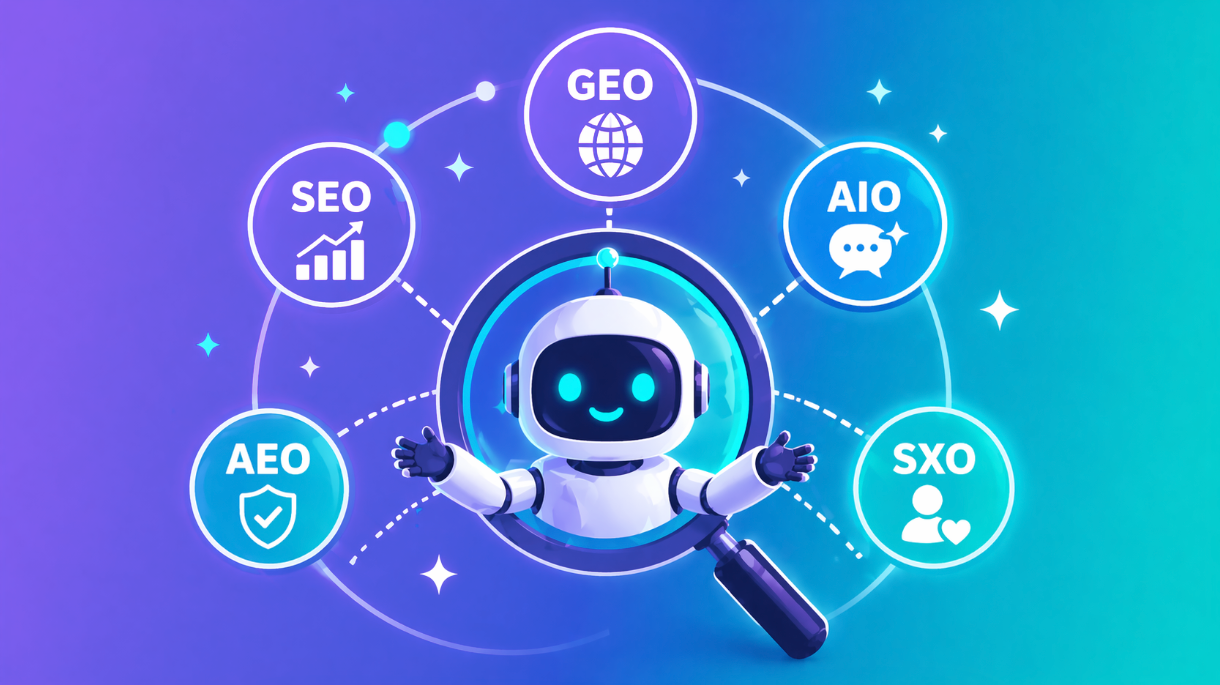
Every conference deck and vendor pitch is introducing a new AI search acronym. If you are trying to figure out which one to "do" — or which one replaces the others — here is what practitioners need to know:
SEO, GEO, AIO, AEO, and SXO are not five different strategies. They are five lenses on one objective — making your content findable, trustworthy, and useful across every surface where people and AI systems look for answers.
The organizations treating these as separate workstreams are overcomplicating it. The ones building a unified content strategy around structure, trust, and usability are already ahead.
Key Insight: AI search traffic converts at 14.2%, compared to 2.8% for traditional Google search — yet only 25.7% of marketers plan to develop content specifically for AI citations.
Sources: Exposure Ninja, AI Search Statistics 2026; SE Ranking, 2025 AI Traffic Research
1. The Distribution Layer Changed — The Fundamentals Did Not
People do not just type keywords into Google anymore. They ask ChatGPT. They talk to Siri. They query Perplexity. They search TikTok and scroll Reddit for unfiltered opinions.
Clear, structured, trustworthy content still wins. What shifted is where that content needs to show up. A single piece of content now needs to perform in traditional search results, AI-generated answers, voice responses, and zero-click environments — sometimes simultaneously.
We call this the "content must perform twice" reality. Each of the five acronyms below describes a different dimension of that reality.
2. SEO: Search Engine Optimization
SEO is the foundation. It is how content gets structured so search engines can crawl, interpret, and rank it.
What changed: SEO is no longer just feeding Google. The same signals that drive rankings — heading hierarchy, semantic structure, internal links, Article and Organization schema — are exactly what ChatGPT, Perplexity, and Google AI Overviews use to decide which content to surface and cite.
SEO did not get replaced. It got promoted. It now powers visibility across both traditional and AI-driven search.
The Princeton University/Georgia Tech GEO research confirmed this relationship from the opposite direction: traditional SEO tactics like keyword stuffing actually decreased AI visibility by 10%. The signals that help with AI citation — clear structure, credible sourcing, semantic clarity — are the same signals that drive sustainable SEO performance.
Key Insight: Over 80% of AI-driven traffic goes to pages updated within the past two years. Only 3.6% of AI-referred traffic goes to pages older than four years.
Source: Seer Interactive, 2025 AI Citation Research
3. GEO: Generative Engine Optimization
GEO focuses on making content interpretable by large language models so they can extract from it and cite it when assembling answers — even when no click-through happens.
This distinction matters. AI tools do not rank pages the way Google does. They pull fragments from multiple sources and synthesize responses. If your content is semantically clear and well-structured, you are more likely to be the source those fragments come from.
In practice, we see Perplexity consistently pulling from pages that use FAQ sections with specific, factual answers. Google AI Overviews favor content with clear heading hierarchy and direct statements over pages that bury the answer under three paragraphs of context-setting.
The academic foundation is solid. The landmark 2023 Princeton/Georgia Tech study tested nine distinct optimization methods across 10,000 queries and found that three tactics delivered 30-40% visibility improvements in AI-generated responses:
- Statistics Addition: Replace qualitative descriptions with quantitative data. "AI search traffic converts significantly better" is weaker than "AI search traffic converts at 14.2%, compared to 2.8% for traditional Google search."
- Cite Sources: Link to credible external sources — academic research, government data, industry publications. AI systems assess outbound links as credibility signals.
- Quotation Addition: Incorporate attributed quotations from recognized experts in the relevant field. AI systems frequently extract quotations as evidence within their responses.
Structurally, GEO-optimized content should be modular — each section capable of standing alone as a complete, useful unit of information that an AI system can extract independently.
GEO Tactics That Move the Needle
- Heading hierarchy that mirrors how people actually ask questions — not internal marketing language
- Natural language over keyword-stuffed phrasing
- FAQ sections using FAQPage schema — AI systems pull from Q&A formats disproportionately
- Lead with a direct answer within the first 40-60 words of each section
- Specific, citable statements — numbers, definitions, process steps — over vague generalizations
4. AIO: AI Optimization
AIO is about trust signals. Large language models do not just evaluate what you say — they evaluate whether you are credible enough to cite.
That credibility comes from two places. On-site: expert bylines, review dates, structured data, citations to authoritative sources. Off-site: third-party mentions, digital PR, consistent NAP data, backlinks from high-authority domains.
Google AI Overviews, for example, consistently surfaces third-party validation when answering recommendation queries. When someone asks "best orthopedic surgeons in Reno," the AI is not pulling from the surgeon's own website first — it is looking at directory listings, review aggregators, and rankings from sources like U.S. News & World Report.
Search Engine Land's GEO analysis confirms that earned mentions — customer reviews on G2 or Trustpilot, industry journalist coverage, community discussions on Reddit or Quora — all contribute to the signal density AI uses to determine whether a brand is credible enough to recommend.
AIO Tactics That Move the Needle
- Author bylines with verifiable credentials on every content page
- Last-reviewed or published dates displayed prominently
- Person, Organization, and MedicalWebPage schema where applicable
- A digital PR strategy that builds third-party mentions — not just backlinks
- Information consistency across directories, social profiles, review platforms, and your website
5. AEO: Answer Engine Optimization
AEO targets zero-click environments: voice assistants, featured snippets, quick answer boxes, and AI-generated summaries. These systems need concise, direct answers they can serve immediately.
The pattern is straightforward. Pages that lead with the answer — not the context — get selected for zero-click placement. Voice assistants like Siri and Alexa pull from the same structured data that feeds featured snippets, which means HowTo and FAQPage schema do double duty here.
When Google AI Overviews appear in search results, zero-click search rates jump to 43%, compared to 34% without an Overview. In Google's AI Mode, that number rises to 93%. Content that is not structured for answer extraction is increasingly invisible in these environments.
Key Insight: When AI Overviews appear, zero-click rates jump to 43%. In Google's AI Mode, zero-click rates reach 93%.
Source: Search Engine Land, 2025
AEO Tactics That Move the Needle
- Answer the primary question within the first 100 words of the page
- Implement FAQPage and HowTo structured data markup
- Write for spoken queries — "How do I schedule an appointment with a cardiologist" not "cardiology appointment scheduling"
- Keep answer paragraphs under 50 words for snippet eligibility
6. SXO: Search Experience Optimization
SXO connects findability to action. It bridges the gap between "they found your content" and "they did something useful with it."
Search engines and AI systems increasingly factor in engagement signals. Bounce rate, time on page, scroll depth, and conversion events all feed back into how content gets ranked and surfaced. A page that ranks well but loses visitors in three seconds is training the algorithm to deprioritize it.
This is where UX and search strategy converge. A well-structured Find a Doctor page, for example, does not just serve patients — it serves AI systems. When ChatGPT can extract a phone number, physician list by specialty, and scheduling instructions from a single page, that page becomes more citable. The user experience is the optimization.
SXO Tactics That Move the Needle
- Plain language throughout — if your audience has to decode your content, they leave
- Clear calls to action above the fold, not buried at the bottom
- Engagement pathways that guide users to a next step — schedule, call, download, explore
- Fast-loading, mobile-first pages — Core Web Vitals still matter for both Google and AI Overviews
7. Where All Five Acronyms Overlap
These five acronyms share more DNA than their separate branding suggests. The practical tactics converge across multiple disciplines:
- Structured heading hierarchy serves SEO, GEO, and AEO simultaneously
- Schema markup (FAQPage, HowTo, Organization) strengthens SEO, GEO, AIO, and AEO
- Expert credibility signals (bylines, review dates) reinforce SEO and AIO
- Natural language and Q&A format improves performance in GEO and AEO
- Third-party mentions and digital PR feed AIO and SXO authority signals
- Answer-first content structure benefits SEO, GEO, AEO, and SXO
- Consistent information across platforms strengthens SEO, AIO, and SXO
The takeaway: execute well on structured content, schema implementation, and trust signals, and you are making progress across all five disciplines simultaneously. No separate workstreams required.
8. AI-Ready Content Checklist
Run every piece of content through this before publishing.
Structure and Format
- Clear H2/H3 heading hierarchy using natural language questions
- Primary question answered in the first 100 words
- FAQ or Q&A sections where the topic warrants it
- Answer paragraphs under 50 words for snippet eligibility
- Modular sections that can stand alone as citable units
Trust and Authority
- Author byline with credentials
- Published or last-reviewed date
- Citations and links to authoritative external sources
- Schema markup: Article, FAQPage, HowTo, Organization, Person
Findability
- Internal links to related content across the site
- Consistent information across directories and platforms
- Active digital PR building third-party mentions
Experience
- Plain language with no unexplained jargon
- Clear calls to action above the fold
- Mobile-first, fast-loading pages passing Core Web Vitals
- Logical next step for every visitor
The Strategy Is Execution, Not Acronyms
The organizations that will perform well in AI search are not mastering five separate optimization strategies. They are building content that is genuinely useful, clearly structured, and demonstrably trustworthy — then implementing the technical layer that makes it machine-readable: schema, site architecture, trust signals, and consistent publishing.
That has been the playbook all along. AI search raised the stakes on execution.
At Elevated Strategy AI, this is the work we do with clients — AI search visibility audits, content structure overhauls, schema implementation, and team training that turns these concepts into repeatable processes. If your content strategy has not been pressure-tested against how AI systems select and cite sources, that is the gap to close first.
The question is no longer whether AI is changing how people discover and choose brands.
The question is whether your brand shows up when they ask.
FAQ
What do SEO, GEO, AIO, AEO, and SXO stand for?
SEO is Search Engine Optimization. GEO is Generative Engine Optimization. AIO is AI Optimization. AEO is Answer Engine Optimization. SXO is Search Experience Optimization. These five acronyms describe different dimensions of the same goal — making content findable and citable by both humans and AI systems.
Are SEO, GEO, AIO, AEO, and SXO five separate strategies?
No. They are five lenses on one unified content strategy. The core tactics — structured content, schema markup, trust signals, answer-first formatting, and strong user experience — serve multiple disciplines simultaneously. Organizations should build one integrated strategy, not five separate workstreams.
Does GEO replace traditional SEO?
No. Traditional search still accounts for more than 90% of organic website traffic. GEO complements SEO by optimizing content for AI-generated citations and recommendations. The strongest strategies combine both — content that ranks in traditional search and gets cited in AI-generated answers.
What is the fastest way to improve AI search visibility?
Three high-impact starting points: implement FAQPage and Article schema markup across key pages, restructure content to lead with direct answers in the first 40-60 words of each section, and add quantitative statistics with attributed sources. The Princeton/Georgia Tech GEO study found these tactics delivered 30-40% visibility improvements in AI-generated responses.
How do you measure performance across these five disciplines?
Traditional SEO metrics (clicks, rankings, impressions) cover SEO and SXO. AI-specific metrics — AI Visibility Rate, Citation Rate, Content Extraction Rate, and AI referral traffic in GA4 — cover GEO, AIO, and AEO. Tools like Semrush AI Visibility Toolkit and SE Ranking's ChatGPT Visibility Tracker provide platform-specific data.
Which content pages should be prioritized for AI search optimization?
Prioritize high-intent pages first: service line or product pages, provider or team directories, location pages, FAQ content by specialty or topic area, and any pages targeting queries where AI Overviews currently appear in search results. These pages have the highest citation potential and the most direct impact on conversion.

CEO & Founder, Principal AI Strategist
Sidnie is the CEO and founder of Elevated Strategy AI. Her approach to AI is systems-first — not what a tool does in a controlled demo, but what holds up when it runs every day across real teams, real data, and real edge cases. She came to it through years of CRM architecture and automation work.