Your CMS Is Holding Your AI Strategy Back — Here's How Sanity Fixes That
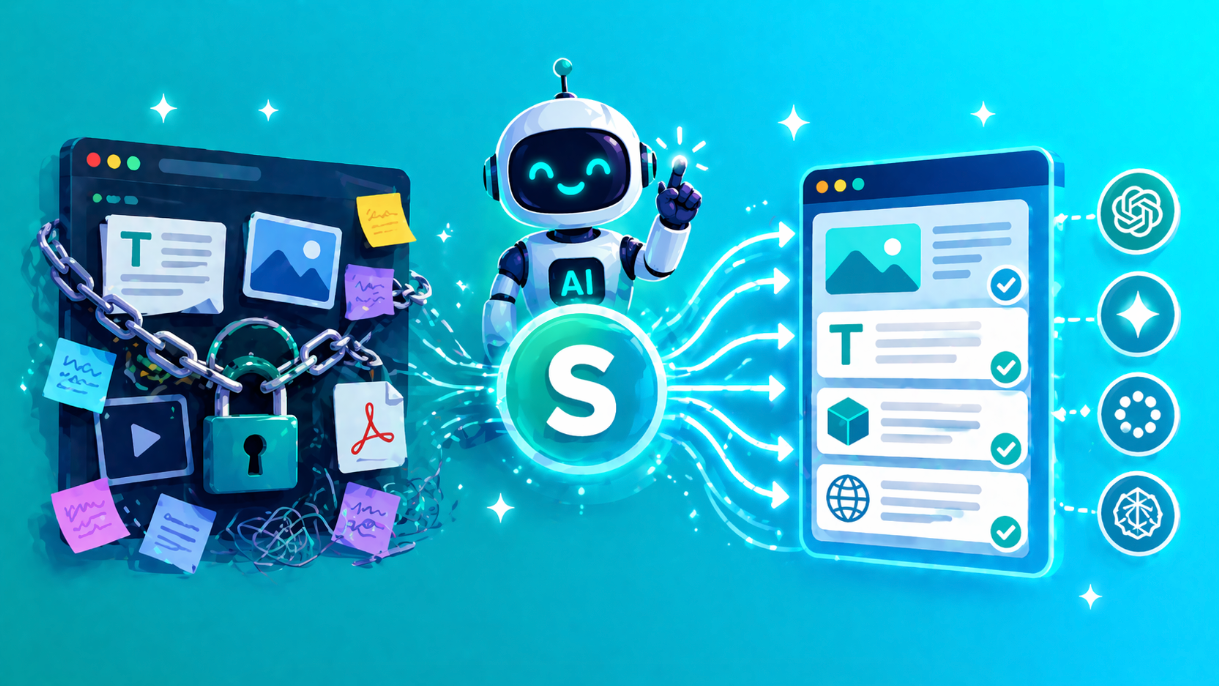
The way you structure content today determines how well AI can work with it tomorrow.
Most health systems and digital teams are asking the wrong question. They're asking "How do we add AI to our website?" when they should be asking "Is our content infrastructure even ready for AI?"
The honest answer, for the majority of organizations still running on legacy CMS platforms or poorly structured headless setups: No. It's not.
That's where Sanity changes everything.
Content Structure Is the Foundation of AI Readiness
AI doesn't browse your website. It doesn't read your paragraphs the way a human does. It processes, retrieves, and generates based on structured data — discrete, labeled, queryable fields that carry meaning beyond formatting.
When your content lives in a monolithic WYSIWYG editor — a blob of HTML that conflates layout with meaning — AI tools have almost nothing to work with. They can't distinguish a physician's name from a department name. They can't tell a service description from a legal disclaimer. They can't reliably surface the right content in the right context.
Structured content solves this. And Sanity is built around structured content from the ground up.
What Makes Sanity's Content Model Different
In Sanity, you don't just publish content — you define it. Every piece of content lives as a structured document in the Content Lake, Sanity's real-time content database. That means:
- Every field has a name, a type, and a purpose. A provider profile isn't a page with text — it's a schema with defined fields for name, specialty, accepting patients status, languages spoken, affiliated locations, and more.
- Portable Text replaces raw HTML. Sanity's rich text format keeps semantic meaning intact while stripping out layout dependency. AI can parse it. APIs can consume it. Any frontend can render it.
- Content is channel-agnostic by design. The same structured record powers your website, your chatbot response, your mobile app, and your AI-generated summaries — without duplication or manual reformatting.
This isn't a feature. It's the architecture. And it's what separates AI-ready content infrastructure from everything else.
Why This Matters for Healthcare Marketing
In healthcare, content complexity is unusually high. You're managing:
- Provider directories with dozens of dynamic attributes
- Service line pages that must align with clinical terminology and EHR data
- Location-specific information with hours, services, and accessibility details
- Regulatory and compliance constraints that require version control and governance
- Bilingual content that needs to be structurally equivalent, not just translated
Legacy CMS platforms treat all of this as a formatting problem. Sanity treats it as a data problem — which is exactly what it is.
When your content is properly structured in Sanity, AI tools like Canvas (Sanity's AI-native content creation environment) and Content Agent can do things that are simply impossible in a traditional setup:
- Generate first drafts that pull from structured source data rather than starting from scratch
- Maintain consistency across hundreds of service line pages at scale
- Surface the right content variant to the right audience in real time
- Feed structured outputs directly into downstream systems like your CRM, EHR integrations, and analytics stack
The AI Tools Built Into the Platform
Sanity doesn't bolt AI on as an afterthought. It's woven into the platform:
Canvas is Sanity's AI-powered writing environment. Because Canvas works directly within the Content Lake — against your actual structured schema — the AI understands your content model. It knows what a "service line" is. It knows what fields need to be populated. It generates content that fits, not content you have to retrofit.
Content Agent takes this further, enabling automated content workflows. Think of it as AI that operates on your content infrastructure at scale — auditing, generating, transforming, and distributing content based on rules you define.
This is the difference between using AI as a novelty and using it as infrastructure.
What "AI-Ready" Actually Looks Like in Practice
Here's a concrete example. Imagine you're launching a new neuroscience service line across five locations.
In a traditional CMS: Your team writes five separate pages. Content is duplicated, formatting varies, structured data doesn't exist. When an AI tool queries for information about your neuroscience services, it either gets incomplete results, conflated data, or nothing useful at all.
In Sanity: You define a serviceLineDocument schema with structured fields for condition types, related providers, affiliated locations, procedure types, and clinical differentiators. Each location references the same structured data objects. Canvas generates location-specific page variants based on that schema. Your AI chatbot can query the Content Lake directly. Your analytics platform gets clean, labeled events tied to real content structure.
One source of truth. Infinite outputs. Total AI readiness.
The Strategic Imperative
AI is not coming to content — it's already here. The organizations that will win are not the ones that add AI tools to broken content infrastructure. They're the ones that build content infrastructure worthy of what AI can do.
Sanity's structured content model is that infrastructure. It's not a CMS decision. It's a future-readiness decision.
If your content can't be read by a machine, it can't be scaled by AI. And if it can't be scaled by AI, your team will spend the next decade doing manually what your competitors automate in minutes.
Ready to Build AI-Ready Content Infrastructure?
At Elevated Strategy AI, we specialize in Sanity implementation for healthcare and regulated industries — from schema design and CMS migration to AI content workflow architecture.
Whether you're evaluating a move away from Sitecore, AEM, or a custom CMS, or you're ready to make your existing Sanity setup do more, we can help you build content infrastructure that's ready for whatever AI demands next.
FAQ
What is structured content and why does it matter for AI?
Structured content is content organized into defined, labeled fields rather than blocks of HTML. AI tools — including search engines, chatbots, and generative AI — rely on structured data to understand, retrieve, and surface the right information in the right context. Without it, your content is invisible to AI-driven experiences.
How does Sanity CMS make websites AI-ready?
Sanity stores content in a real-time database called the Content Lake, where every field is named, typed, and queryable. This means AI tools can access your content programmatically — powering chatbots, personalization engines, and generative workflows — rather than scraping unstructured HTML.
What is headless CMS and is it right for healthcare organizations?
A headless CMS separates content management from content presentation, allowing the same structured content to power websites, mobile apps, patient portals, and AI interfaces simultaneously. For healthcare organizations managing complex, multi-channel content across service lines and locations, headless architecture significantly reduces duplication and improves content governance.
What is the difference between Sanity Canvas and a traditional content editor?
Traditional content editors produce formatted HTML tied to a specific page layout. Sanity Canvas is an AI-native writing environment that generates content directly against your structured schema — meaning outputs are immediately usable across any channel without reformatting. For teams managing high content volume, Canvas dramatically accelerates production while maintaining consistency.

CEO & Founder, Principal AI Strategist
Sidnie is the CEO and founder of Elevated Strategy AI. Her approach to AI is systems-first — not what a tool does in a controlled demo, but what holds up when it runs every day across real teams, real data, and real edge cases. She came to it through years of CRM architecture and automation work.